
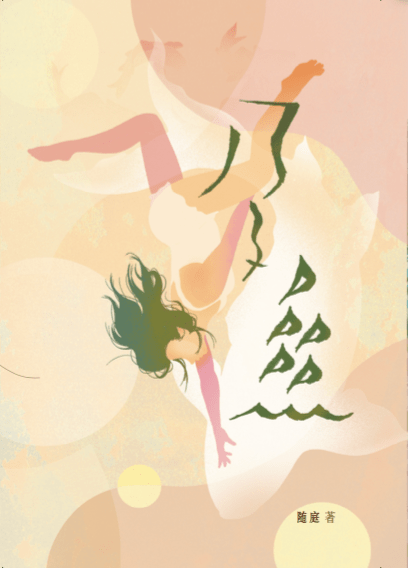
Fish Birth《孕鱼》
Fish Birth is a collection of eight short stories. The title story, which explores issues associated with pregnancy and existential problems modern people struggle with, won the Golden Point Award in 2015. Another award winning story, Old Shop is a touching tale of the overlapping destinies of an old shop and its owner, showing the conflict between traditional heritage and modern development. In the collection, Sui Ting presents untold stories of modern urban life from a female perspective.
《孕鱼》收录八部短篇小说,包括2015年金笔奖中文小说组首奖《孕鱼》与2015年新加坡大专文学奖小说组首奖、联合早报金奖作品《老店》。《孕鱼》是关于一个女人遭遇海难时将整条鱼生食,然后怀了身孕的故事。随庭以充满奇幻色彩的人鱼意像,隐喻女性生育的命题,刻画出人的存在状态与意境。而《老店》则叙述得了怪病的老店主突入一段历史记忆,交错地叙述老店与老主人命运重叠的结局,情节虚实相生,展现传统和现代发展之间的格格不入,深刻又触动人心。 本地作家杜南发评价 “《老店》和《孕鱼》风格迥异,文笔随叙事而变化,表现作者舒展自如的多样化功力。”
Text Synopsis 小说梗概
Fish Birth is a collection of eight short stories. The stories collectively capture the Pervasive ennui, loneliness and hardships of urban life and relationships. Except for the first story “Lao Dian (Old Shop),” all stories in the collection are mainly focalised through a female perspective: notably, five of the short stories feature female protagonists who are either unnamed or possess made-up names.
Fish Birth is centered around the ineffable loneliness of urban life: old and forgotten shophouses, women who work far from home, depressed and overworked fathers, mothers who prostitute themselves for their children, the third wheel in a marriage, the feeling of emptiness after a breakup. The protagonists are lonely, anxious, indignant, and eager to find a way out of their loneliness.
孕鱼 (Fish Birth)
The protagonist Angel is shipwecked while on vacation. To survive while adrift at sea, she eats a black fish whole on a whim and discovers herself mysteriously pregnant soon after. The androgynous foetus which Angel believes to be the black fish trashes violently in her womb and can only be pacified when Angel sits in a bathtub filled with water. As Angel’s body starts to change over the course of her pregnancy, she grows increasingly alienated from her own body: the presence of the strange foetus takes up primacy in her experience of her body, her memory starts to fail, her eyes become pale like that of a fish, and she becomes mute. At the end, Angel gives birth to an unknown eldritch body and finds herself completely transformed into a fish.
眼眶 (Eye Socket)
The nameless protagonist is alicted by a strange condition which renders her body exceedingly dry, She is unable to perspire, and also loses her ability to reach orgasm and her sexual desire wanes as a result. Drained of desire and a corresponding zeal for life, the men in the protagonist’s life lose interest in her, the exception being the earnest driver of her daily shuttle to work who strikes up a shaky relationship with her. Despite the driver’s attempts to court her, the protagonist remains dispassionate and listless due to her afliction until a chance encounter with a vigorously urinating male horse in a cemetery. Thereafter, the protagonist’s bodily functions are restored-a soothing and unceasing pleasure spreads throughout her body, her eyes become filled with tears and it is as if her passionless heart had been cured in that instant. Later, when the protagonist once again meets with the driver, weeping with joy, she directs him to identify her eye sockets as the sexiest part of her body.
老店 (Old Shop)
Lao Xiao has been running his barber shop for 59 years. Unable to keep up with the times, Lao Xiao is forced to terminate his business. Right before he shutters his shop, however, Lao Xiao is aflicted by a strange illness which causes him to talk to himself as if he were a deceased person, such as his late wife. The neighbours believe Lao Xiao to be possessed, whereas the doctors diagnose him with dementia. Lao Xiao’s son, Xiao Xiao, thinks otherwise; he believes that his father has the sickness of being detached from reality as a result of his nostalgia and his inability to keep up with modern life At the end of the story, Xiao Xiao arranges an exorcism for his father to banish the spirits of the past” but also acknowledges and engages with the past by way of inviting neighbours to bear witness to Lao Xiao’s ramblings of days gone after and by keeping artefacts from the barber shop in their family home. At the sight of the artefacts in his room, Lao Xiao snaps back to reality and is freed from his strange illness. From then on, Lao Xiao no longer speaks gibberish.
改头换面的那一天 (the day she reinvented herself)
As the curious and befuddled masses attempt to explain politician’s mysteriously vandaliscd oficial portrait, the protagonist Zhuang Zhuang, who is studying abroad, attempts to find renewed meaning in her life upon her rcalisation that her relationship with her boyfriend has grown cold while other aspects of her life appear to be equally insipid. During an attempt to revitalise her love lifeby going on a blind date, Zhuang Zhuang receives a call from her mother informing her of her father’s death, which then spurs her to make immediate arrangements to return home While at the airport awaiting her flight, Zhuang Zhuangs mother calls again to tell her that it was a false alarm and that her father is merely ill. Relieved of her immediate directive to return home, Zhuang Zhuang again feels lost and directionless. Desiring to find- meaning, Zhuang Zhuang follows her impulse to re-route her flight to see the politician’s vandalised portrait.
秋蝉 (Autumn Cicadas)
A mysterious woman abducts Zhuang Dashus son during a class gathering Zhuang investigates his son’s isappearance and realises that the mysterious woman is his ex-lover Shen Xinjing, Visiting Shen’s ex-cellmate in prison, Zhuang learns of the tragic life of Shen following their breakup, including her forced marriage to a divorced policeman in Beijing who was abusive to her.
Singapore Comparative Literature Compendium, edited by Sim Wai Chew and Yow Cheun Hoe, Balestier Academic, Dec 2021.
Reviews 评论
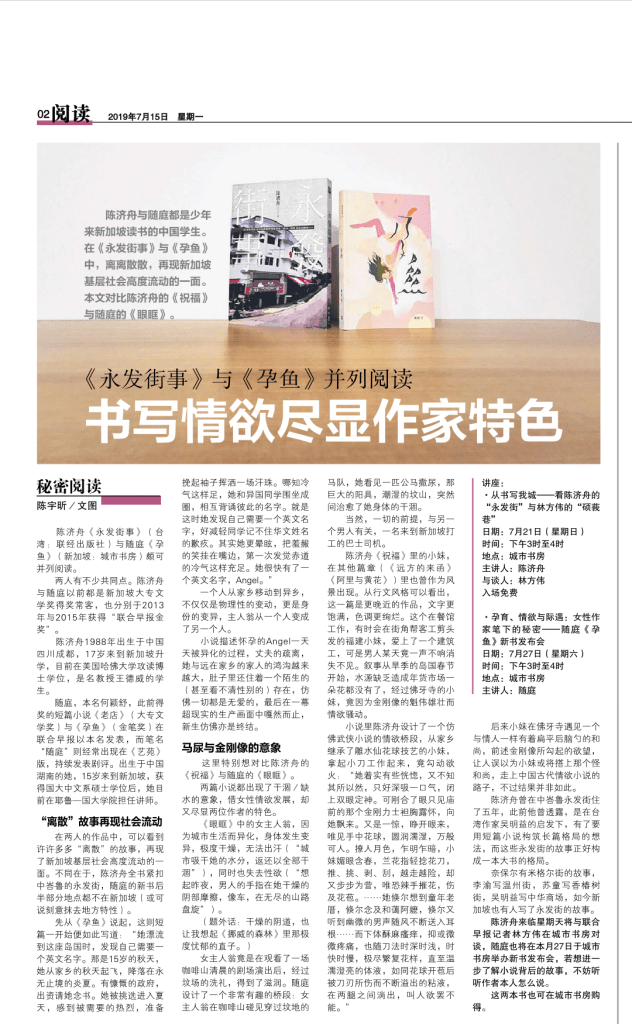
The author has a vivid imagination: her speculative stories capture the fantastic elements of life and yet remain realistic and faithful to daily experience.
Sui Ting is especially adept in her characterization of women – her female characters can be seen as embodied fables that depict the varied (emotional) conditions of womanhood.
Singapore Comparative Literature Compendium, edited by Sim Wai Chew and Yow Cheun Hoe, Balestier Academic, Dec 2021.
新加坡新锐作家随庭试图在极度异化的现代都市寻找自然的微弱踪迹,为我们展示了当代都市中多种维度的隔绝。
〈有脉搏的树——叩问想象的边境〉王楠,《今天》126期“生态与人”专辑。
 Sui Ting 随庭